
Best Low Cost Fitness Watch: Track Your Gains Without Losing Your Change
The Best Low Cost Fitness Watch in 2026: Top Picks at a Glance
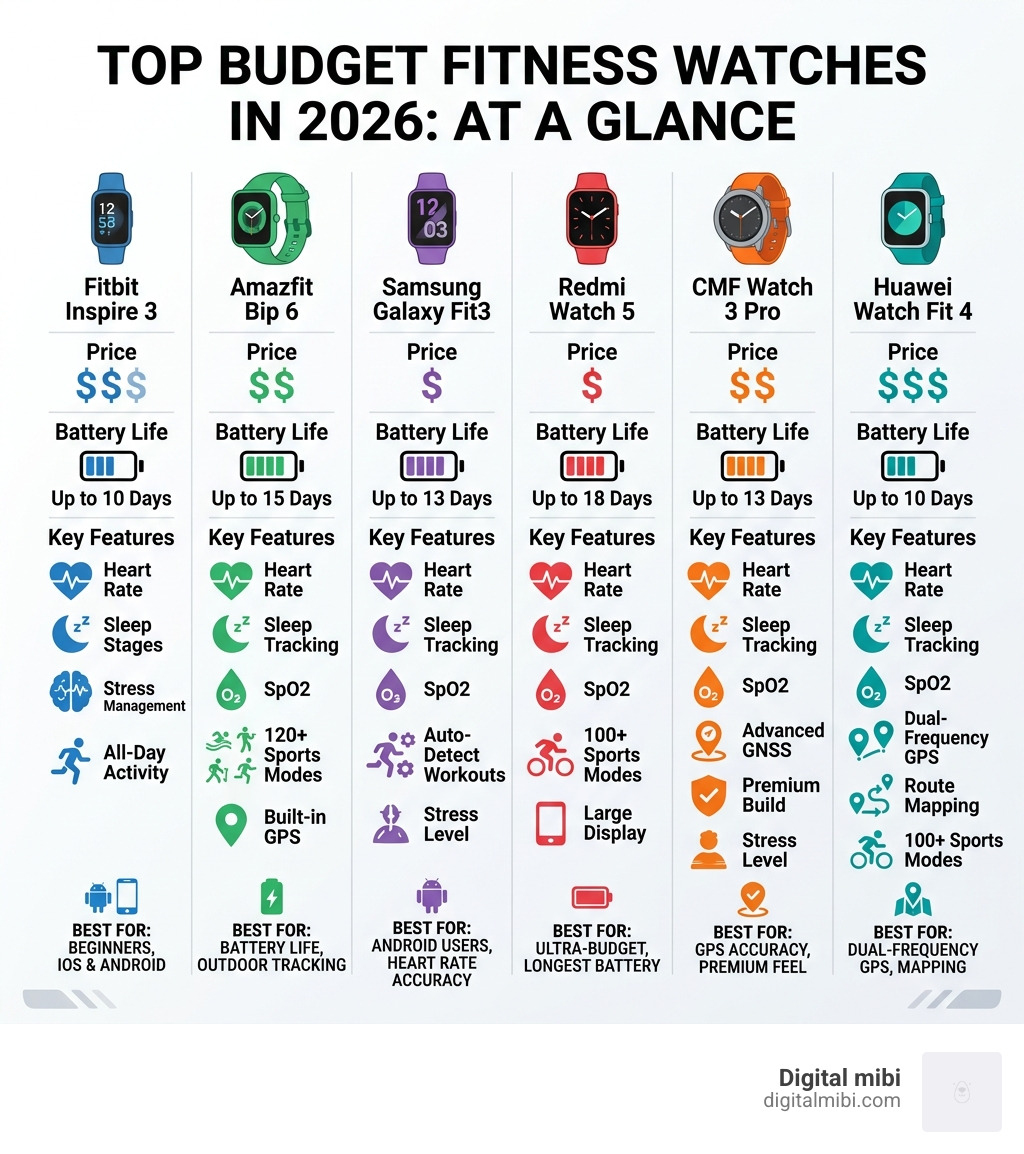
The best low cost fitness watch options in 2026 give you real health tracking without draining your bank account. Here are the top picks:
| Watch | Price | Best For |
|---|---|---|
| Fitbit Inspire 3 | ~$93 | Beginners, iOS & Android |
| Amazfit Bip 6 | $79.99 | Battery life, outdoor tracking |
| Samsung Galaxy Fit3 | ~$42 | Android users, heart rate accuracy |
| Redmi Watch 5 | ~$39 | Ultra-budget, longest battery |
| CMF Watch 3 Pro | $99 | GPS accuracy, premium feel |
| Huawei Watch Fit 4 | ~$134 | Dual-frequency GPS, mapping |
Staying fit on a student budget used to mean choosing between knowing your data and keeping the lights on. Not anymore.
In 2026, budget fitness trackers have quietly caught up to their pricier cousins. Features like heart rate monitoring, sleep tracking, SpO2 sensors, and even GPS — once reserved for $300+ devices — now come standard on watches under $100.
The market has exploded. From Amazfit’s long-battery Bip series to Samsung’s ultra-affordable Galaxy Fit3, there are more solid options than ever. And with Google reportedly planning new Fitbit hardware in 2026, the budget end of the market is only getting more competitive.
The hard part isn’t finding a cheap fitness watch. It’s finding the right one for your needs.
Whether you want to count steps between classes, monitor your sleep, or track a morning run, this guide breaks down the best options clearly — no tech jargon, no fluff.
Key Features to Look for in the Best Low Cost Fitness Watch
When we go hunting for a budget-friendly wearable, it’s easy to get distracted by flashy marketing. However, in 2026, we don’t have to settle for a glorified pedometer. A modern best low cost fitness watch should be a powerhouse of data hidden inside a small, affordable frame.
To get the most value, we look for a specific “Golden Five” list of features. First is heart rate monitoring. This is the foundation of almost every other metric, from calorie burn to stress levels. Second is sleep tracking, which has become incredibly sophisticated. Many budget models now track sleep stages (Light, Deep, and REM) and even provide a “Readiness Score” to tell you if you should hit the gym or hit the snooze button.
Battery life is the third pillar. Unlike high-end smartwatches that need a daily charge, many low-cost options like the Amazfit Bip can last between 10 and 21 days. Fourth is GPS accuracy. If you’re a runner or cyclist, you want a watch that knows where you actually went, rather than just guessing based on your arm swings. Finally, consider the app ecosystem. A watch is only as good as the app on your phone that interprets the data.
Essential Sensors for 2026
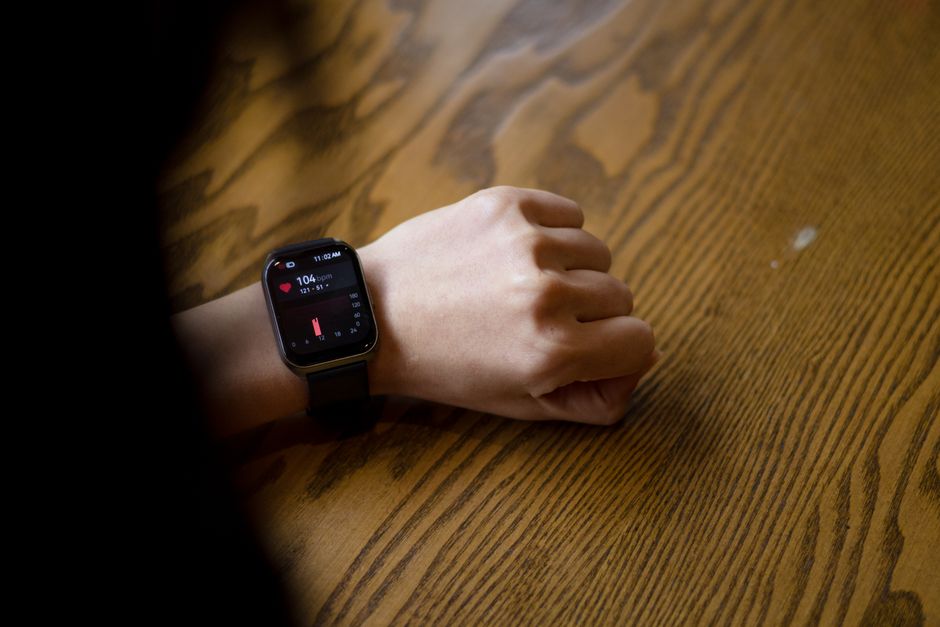
In 2026, the tech under the hood has evolved. Most budget trackers now use advanced PPG (photoplethysmography) sensors to measure blood flow and SpO2 (blood oxygen) levels. We also see high-precision accelerometers that can distinguish between a walk to the library and a frantic sprint to catch the bus. According to Wareable, features like dual-frequency GPS and offline mapping are even starting to trickle down into devices under $150, making them more “capable” than ever before.
Battery Life and Charging Standards
We’ve all been there: you’re ready for a workout, but your watch is at 2%. The best low cost fitness watch options in 2026 solve this with massive battery reserves.
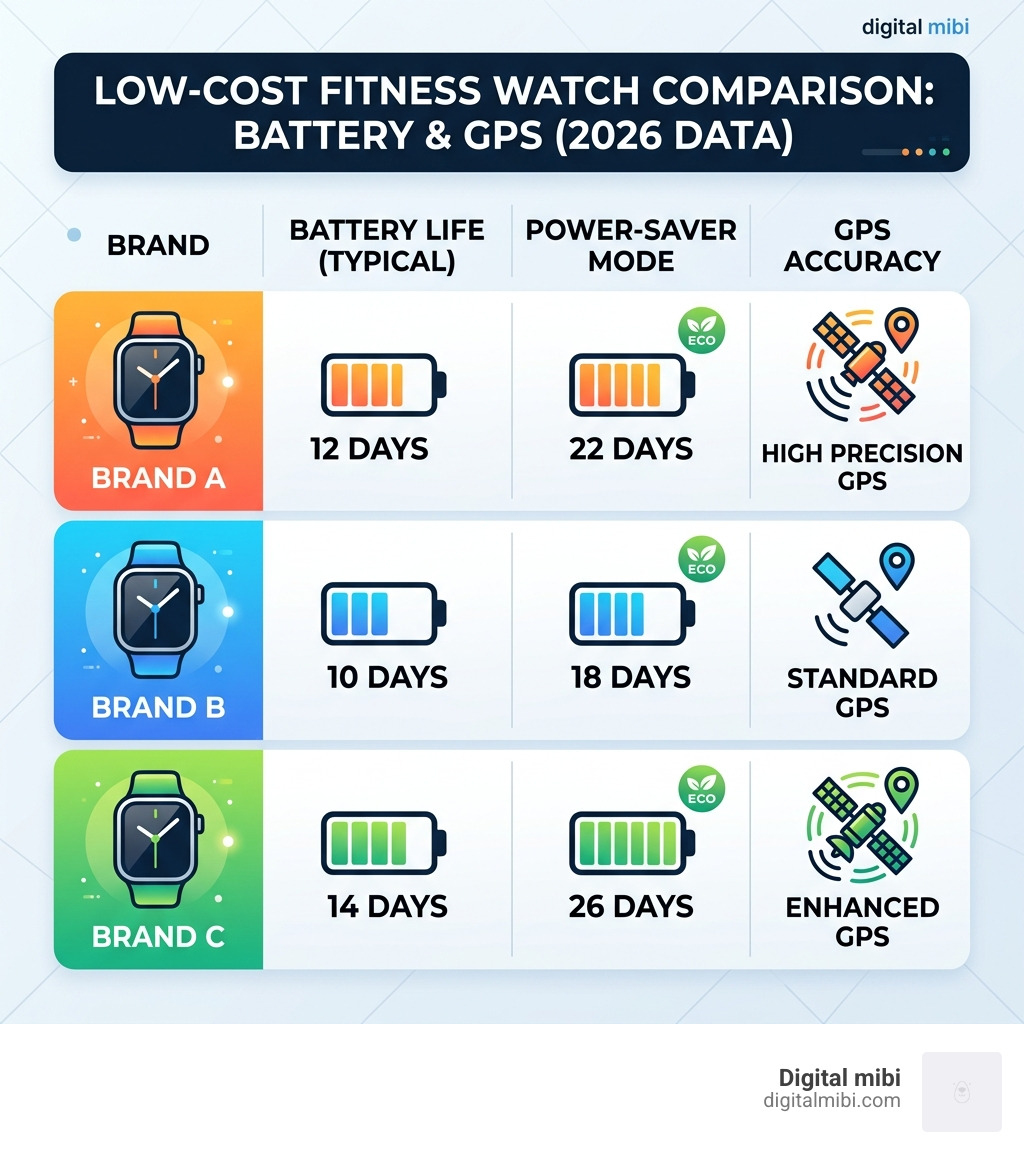
- Typical Use: Expect 10–14 days for most brands like Amazfit or CMF.
- Power-Saver Mode: Some devices, like the Redmi Watch 5, can push this to a staggering 24–26 days.
- Charging: Most have moved to proprietary magnetic pins, though the industry is slowly nudging toward universal standards. A full charge usually takes about 2 hours, which isn’t bad for two weeks of data!
Top-Rated Budget Fitness Trackers for 2026
If you’re looking for the best low cost fitness watch, the market is currently split into three main camps: the established giants (Fitbit, Samsung), the “value kings” (Amazfit, Xiaomi), and the design-forward newcomers (CMF by Nothing).

Best Low Cost Fitness Watch for Beginners
The Fitbit Inspire 3 remains our top recommendation for anyone just starting their fitness journey. Priced under $100 (often around $93 in 2026), it is incredibly user-friendly. It features a bright color screen and tracks all the basic metrics like steps, heart rate, and sleep without overwhelming you with complex data. It’s the “set it and forget it” choice for students who just want to stay active.
Best Low Cost Fitness Watch for Android Users
If you’re already in the Android ecosystem, the Samsung Galaxy Fit3 is hard to beat. Often found on sale for around $42, it offers surprising heart rate accuracy and a beautiful AMOLED display. It integrates seamlessly with Samsung Health, making it a natural extension of your phone for a fraction of the cost of a Galaxy Watch.
Best for Advanced Outdoor Tracking
For the student-athlete or weekend hiker, the Huawei Watch Fit 4 is a standout. At roughly $134, it sits at the higher end of “budget,” but it includes dual-frequency GPS and offline mapping—features usually reserved for watches three times the price. With a 10-day battery and over 100 workout modes, it’s built for those who take their outdoor stats seriously.
Comparing Accuracy and Performance in Cheap Wearables
A common question we hear at Digital mibi is: “Is a $50 watch actually accurate?” The answer in 2026 is a resounding mostly. While a budget watch might struggle with the extreme precision required for Olympic-level training, they are more than sufficient for general health tracking.
In lab tests, budget champions like the Fitbit Charge 6 and Samsung Galaxy Fit3 show heart rate accuracy that rivals premium models during steady-state cardio (like jogging or walking). However, Reddit users often note a slight “lag” in heart rate during high-intensity interval training (HIIT) where your pulse jumps rapidly. As noted by TechRadar, the key is to manage expectations; you are paying for 90% of the accuracy at 20% of the price.
Subscription-Free vs. Membership Models
This is a big one for students. Some brands, like Fitbit, offer a “Premium” tier for deep-dive data. While the basic stats are free, you might miss out on long-term trends or advanced sleep scores without a monthly fee. If you want a subscription-free experience, we recommend Amazfit or Xiaomi. Their Zepp and Mi Fitness apps provide all data upfront with no “paywalls,” offering better long-term value for a one-time purchase.
Build Quality and Durability
Low cost doesn’t have to mean “cheap feel.”
- Water Resistance: Most of our picks feature an IP68 or 5 ATM rating, meaning you can shower or swim with them without worry.
- Materials: We’re seeing more stainless steel frames (like the Bip 5 Unity) and Gorilla Glass screens to prevent scratches during busy campus days.
- Eco-Friendly: Some brands, like Polar, are even experimenting with ocean plastic bands, proving that budget tech can also be sustainable.
Smart Rings and Screenless Alternatives
Not everyone wants a glowing screen on their wrist. In 2026, “invisible” tracking is a major trend. WHOOP 5.0 is the king of screenless trackers, focusing entirely on recovery and strain. While it requires a subscription, it’s a favorite for athletes who want a “health coach” in their ear rather than a watch on their arm.
For those who prefer jewelry, smart rings like the RingConn Gen 2 have become popular budget alternatives. They track sleep and heart rate from your finger, often boasting 10-12 days of battery life. Newcomers like the Hume Band also offer unique metrics like “Metabolic Momentum” without a screen, helping you stay focused on your goals without the distraction of constant notifications.
Frequently Asked Questions about Budget Fitness Trackers
Do cheap fitness trackers require a monthly subscription?
Not all of them! While Fitbit has a premium tier, brands like Amazfit, Samsung, and Xiaomi are generally subscription-free. You buy the watch, download the app, and all your data belongs to you.
How accurate is the GPS on a low-cost fitness watch?
In 2026, even budget watches like the CMF Watch 3 Pro use multi-satellite systems (GPS, GLONASS, Galileo). They are very accurate for tracking distance on runs, though they might take a few extra seconds to “lock on” compared to a $500 Garmin.
Which budget fitness tracker has the longest battery life?
The Redmi Watch 5 currently leads the pack with up to 24 days of battery life on a single charge. If you hate charging your devices, this is the best low cost fitness watch for you.
Conclusion
Finding the best low cost fitness watch in 2026 is all about balancing your specific needs with your budget. Whether you’re a beginner looking for the simplicity of a Fitbit Inspire 3 or an outdoor enthusiast needing the GPS precision of a Huawei Watch Fit 4, there has never been a better time to start tracking your health.
At Digital mibi, we specialize in providing a digital guide for student-friendly tools. We know that as a student, every dollar counts, which is why we focus on tailored recommendations for activity trackers and smartwatches that offer the highest “bang for your buck.” You don’t need to spend a fortune to get fit—you just need the right tool on your wrist.
